LeTreez
A company delivers unique designs, refined craftsmanship premium corporate gifts. All our products predominantly are designed, crafted and manufactured with superior quality veneer wood for our 2D art pieces and 3D miniature models.
Wau Kucing is a popular type of kite. It is a traditional kite that has been played for generations in Malaysia. Wau Kucing is said to have a name from its shape resembling a cat that is sitting from the back corner, starting from the head, the body and the tail of the cat. Typically, Cat will be fitted with a handle or bow on the top. The main objective is to produce a buzzing sound when the bow straps is stretched by the wind. When flown into the air, a loud meow sound is produced. It is believed to be working to scare demons and predict weather conditions the next day. The motives used in this kite are the motive of flowers and plants and their decorations are the same as Wau Bulan.
Wau Bulan is an intricately designed Malaysian moon-kite (normally with floral motives) that is traditionally flown by men in the Malaysian state of Kelantan. It is one of Malaysia’s national symbols. The reverse side of the fifty-cent coin of Malaysia (1989 series) features an intricately decorated Wau Bulan with a hummer on top. Wau Bulan got its name from the crescent moon-like shape of its lower section (Bulan means “moon” in Malaysian Language). Given the right colour, Wau Bulan apparently resembles a rising crescent moon when flown. The size of Wau Bulan is bigger than any other Malaysian traditional kite. The typical size is 2.5 meters in width and 3.5 meters in length. This makes the decorations painted on the kite’s body to be visible when it is flown high in the air. To make it more distinctive, Wau Bulan is normally decorated with large, strong-coloured patterns.
Malay houses are traditional dwellings, originating before the arrival of foreign or modern influences, and constructed by the indigenous ethnic Malay of the Malay Peninsula, Sumatra and Borneo.
Traditional architectural forms, such as tropically-suited roofs and harmonious proportions with decorative elements are considered by traditionalists to still have relevance.
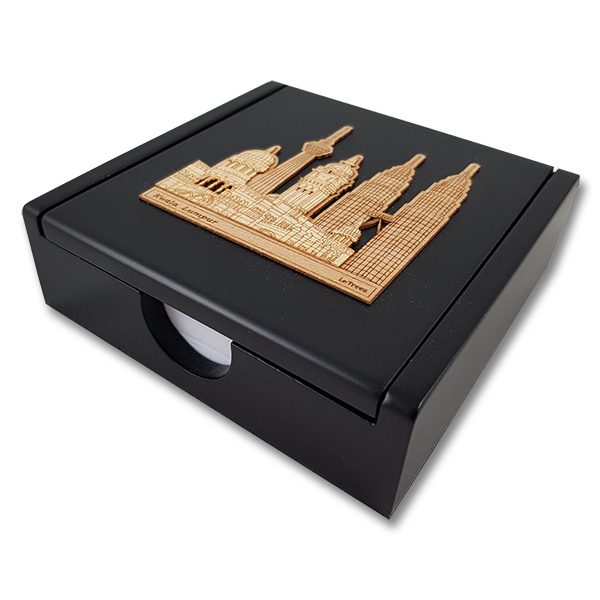
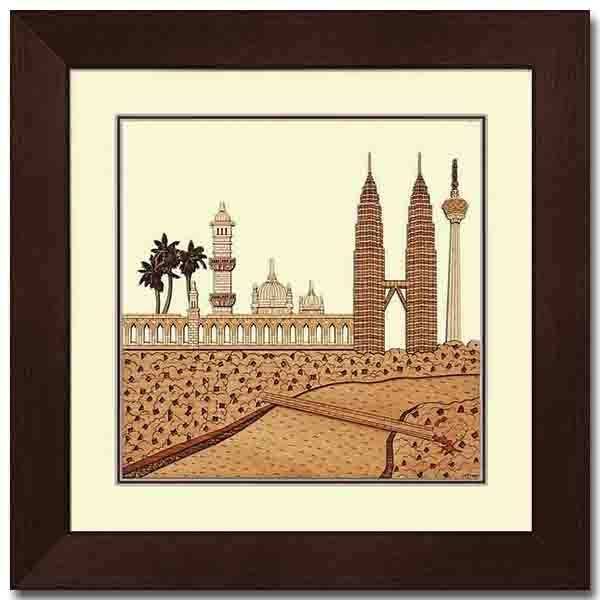
Jamek Mosque, officially Sultan Abdul Samad Jamek Mosque is one of the oldest mosques in Kuala Lumpur, Malaysia. It is located at the confluence of the Klang and Gombak River and may be accessed via Jalan Tun Perak. The mosque was designed by Arthur Benison Hubback, and built in 1909.
The name “Jamek” is the Malay equivalent of the Arabic word (جامع) meaning a place where people congregate to worship. It is also referred to as “Friday Mosque” by the locals.
The Sultan Abdul Samad Building is a late nineteenth century building located along Jalan Raja in front of the Dataran Merdeka (Independence Square) and the Royal Selangor Club in Kuala Lumpur, Malaysia. The building originally housed the offices of the British colonial administration, and was known simply as Government Offices in its early years. In 1974 it was renamed after Sultan Abdul Samad, the reigning sultan of Selangor at the time when construction began.
The building houses the offices of the Ministry of Information, Communications and Culture of Malaysia. It once housed the superior courts of the country: the Federal Court of Malaysia, the Court of Appeals and the High Court of Malaya. The Federal Court and the Court of Appeals had shifted to the Palace of Justice in Putrajaya during the early 2000s, while the High Court of Malaya shifted to the Kuala Lumpur Courts Complex in 2007.
The Klang River winds through Malaysia’s capital city of Kuala Lumpur and flows through the most densely populated area of the Southeast Asian country. Over the years and in the wake of rapid development in the city, the river became increasingly polluted and experienced intensified flooding during storm seasons. It became the backdoor of development and a dumping ground that is disconnected from people’s daily lives.
To reconnect the city, the river and her people, Kuala Lumpur City Hall launched the River of Life project in 2012 and AECOM was chosen as a delivery partner through an international design competition. River of Life is one of Malaysia government’s Economic Transformation Programs, an initiative which combines high-impact projects and programs to elevate the country to developed nation status.
River of Life will deliver affordable housing for more than 35,000 new residents, one million square meters of commercial space, more than 27,000 new employment opportunities, raise the public transportation usage within the master plan area from 15 per cent to 60 per cent and reduce traffic demand by 15 per cent by 2020.
The Sultan Abdul Samad Building is a late nineteenth century building located along Jalan Raja in front of the Dataran Merdeka and the Royal Selangor Club in Kuala Lumpur, Malaysia. The building originally housed the offices of the British colonial administration, and was known simply as Government Offices in its early years. In 1974 it was renamed after Sultan Abdul Samad, the reigning sultan of Selangor at the time when construction began.
Kuala Lumpur City Centre (KLCC) is a multipurpose development area in Kuala Lumpur, Malaysia.
Designed to be a city within a city, the 100-acre site hosts the tallest buildings in the city are currently The Petronas Twin Towers, which rise 1,483 feet (452 m) in the Kuala Lumpur City Centre and were the world’s tallest buildings from 1998 to 2004.
Tugu Negara
The National Monument is a sculpture that commemorates those who died in Malaysia’s struggle for freedom, principally against the Japanese occupation during World War II and the Malayan Emergency, 11,000 people who died during the 12-year Malayan Emergency (1948 until 1960). It is located in the Federal capital, Kuala Lumpur. It is the world’s tallest bronze freestanding sculpture grouping. Commissioned in 1963 and constructed in 1966, the sculpture that stands as a centrepiece of the monument is 15 meters (49.21 feet) tall.
KOTA DARUL EHSAN
Kota Darul Ehsan is a row of arches symbolizing the border on Malaysian Federal Highway between the Federal Territory of Kuala Lumpur and Malaysian state of Selangor. It is the biggest arch in Malaysia. As a commemoration of the cession of Kuala Lumpur to the federal government to form a Federal Territory by Selangor.